Wednesday, July 7, 2010

Once upon a time in Munkegaard (Denmark)...

Arne Jacobsen imagined a school...


http://ribambins.canalblog.com/archives/2010/05/12/15985186.html


The project began in april 1949 : from its outset the basic idea was to build a large school (850 children) in which the advantages of a small one were incorporated. For example the concept of dividing the school into pairs of classrooms, each having a small court or garden, quiet and home-like, came from this aspect in small school design.
Within the architectural concept, Jacobsen designed dedicated furniture in 1955 : he created evolutive desks, in three sizes according to the pupils' age. Fritz Hansen produced around 700 pieces.

And we found an extraordinary specimen :


Wouldn't you go back to school then?

Tuesday, July 6, 2010

Heart and flowers : "Madame est servie"...

What do you think of this round matching table with its tripod chairs in teak, designed in 1952 by Hans Wegner and produced by Fritz hansen (you can also find them in oak)? As convenient as beautiful, aren't they? 


And the chairs bear such a beautiful name : heart chairs (model FH 4103)... When I look at them, they also seem to me like flowers, blossoming or closing their petals...


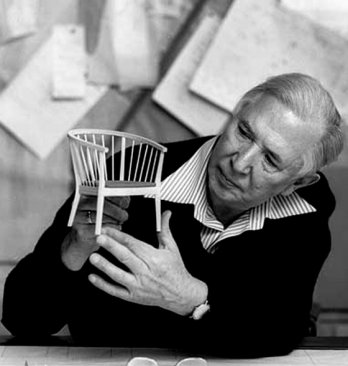
Hans J. Wegner was born in 1914 in Denmark, the son of a shoemaker ; he died very recently three years ago.

At the age of 17 as an apprentice, his first design experiments took form in the workshop of a cabinetmaker, H. F. Stahlberg. Then, when he was 20, from 1936 to 1938, he attended the School of Arts and Crafts in Copenhagen before working as an architect.

As a young architect, Wegner joined Arne Jacobsen and Erik Møller in Århus, working on furniture design for the new Århus city hall in 1940. At the same time he began collaborating with master cabinetmaker, Johannes Hansen, who was a driving force in bringing new furniture design to the Danish public. He started his own design office in 1943.

Among Danish furniture designers, Hans J. Wegner is considered one of the most creative and productive. He has received practically every major recognition given to designers, including the Lunning prize, the grand prix of the Milan Triennale, Sweden’s Prince Eugen medal and the Danish Eckersberg medal. Wegner is an honorary Royal designer for industry of the Royal Society of Arts in London. Almost all of the world’s major design museums – from The Museum of Modern Art in New York to Die Neue Sammlung in Munich – include his furniture in their collections.

(Last picture : http://www.egodesign.ca/_files/articles/blocks/6703_hans_wegner.jpg)


Tuesday, June 29, 2010

It's summer time...

... holiday time, time to travel! What about a vintage design hotel in Prague ?


In the center of old Prague, Hotel Sax has been developping a vintage project. 


Lobby, breakfast & dining rooms and every room or suite have an original appearance : you are surrounded with the atmosphere, the shapes and the colors of the design you prefer. In the 1950s, furniture pieces by Charles and Ray Eames, George Nelson, Hans Wegner, Gio Ponti or Poul Henningsen ; for the 1960s, Panton, Aarnio, Saarinen... but it's also up to you to choose the 1970s... 
Let's travel through design history of the mi-20th Century !


Amazing, isn't it?

For more please see : 
http://195.122.208.4/saxcz/_new/index.php?menu=vintagedesign&lang=2
http://www.hotelsax.cz

Monday, June 28, 2010

Trendy Scandinavian mood...


The trendy "Smallable" website presents pieces coming from an interesting Parisian showroom : 


In this gallery, located in Le Marais, rue Vieille du Temple, you can feel the modernist design spirit, inspired by Scandinavian forms and materials. Stylist, collector and designer Gaëtane Raguet features original designof the 50's to the 70's. She also presents her own "vintage inspired" creations : wallprints, seating, graphic lighting and other contemoraray accessories.


For more, please see :

Wednesday, June 23, 2010

This print could be our flag...


"I just wrapped up a personal project that’s been on my backburner for some time, an illustrated collection of my favourite iconic mid-century modern furniture. Included are designs by Eames, Jacobsen, van der Rohe, le Corbusier, and more, forty pieces in all. It started as a project to develop my editorial illustration – to find a way of working with a certain character, tone & simplicity – for when things need to be communicated more abstractly than with the objectivity of technical illustration", explains James Provost, an artist/illustrator, specialized in highly detailed and accurate illustrations of science and technology subjects.

And here are some closeups of the illustrations :

"Fried Egg Chair", Hans Olsen, c. 1960
"Egg chair", Jacobsen, 1958
"Ball chair", Aarnio, 1963
Panton

Tuesday, June 22, 2010

A colorful Dutch desk at the bend of a path...

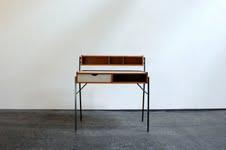
Last week-end, we were wandering through "Marché Paul Bert", in the pittoresque "puces" of Saint-Ouen to find Jacobsen's pieces, when, at the bend of a path, we admired this beautiful desk, one of the first designed by Cees Braakman in 1951.


(Marché Paul Bert, allée 5, stand N. 212)

Cees Braakman (1917-1995) was one of the most influentual designers of the Netherlands. He started his career very young already at the age of 17 learning the basics of furniture production. After the second world war, he was sent to the US to study American design and production processes. There he was particularly inspired by the works of the  Eames at Herman Miller. 
The clean, efficient and forward-thinking designs of Braakman paved the way for success for the manufacturer Pastoe during the 1950's and 1960's he worked for from his very beginnnings. Some of Braakman's most reknown designs includes a pioneering series of modular cabinets that was based on self-assembly and could be combined in endless ways and in various materials, as well as the 'U+N' series created during the 1960's. 

Friday, June 18, 2010

In love with the sculptural "Baker Sofa"...


The "Baker Sofa" is known as one of the most beautiful sofas by the hand of Finn Juhl (1912-1989), designed in 1951 for the company Baker Furniture in Grand Rapids, Michigan. This beautiful sofa is in two parts with an upholstered body on a light construction of wood (walnut or teak/ wool upholstery) - a typical example of how Finn Juhl divided the elements in order to create lightness visually as well as constructively. In fact it gives a wonderful idea of the designer's formgiving ability, showing one of his most dynamic designs with its curious backrest seeming almost as though to float on air ( C & P Fiell, "Landmarks of Chair Design", Fill Publishing, 2010). Its sculptural forms are inspired by the modern free art, which interested Finn Juhl very much in his design.


Wish I could find a vintage one...

In 2009, the Danish Company OneCollection (http://www.onecollection.com) reintroduced it to the market. And 59 years after its birth the Baker Sofa actually got an international design award, receiving, on January, the WallPaper Design Award 2010 in the category "Best reissues" !


Finn Juhl, who is regarded as the father of the Danish Design he contributed to introduce in the USA when he became world famous after he designed the Trusteeship Council in the UN building, was born at Frederiksberg in 1912 as son of an autoritarian cloth merchant. Originally he wanted to become an art historian but his father persuaded him to join The Royal Danish Academy of Fine Arts, School of Architecture after his graduation in 1930. During the Summer of 1934 Finn Juhl had a job with the architect Vilhelm Lauritzen, but he resigned in 1945 and started his own drawing office. 
Finn Juhl was not an educated furniture architect, but an all round building’s architect, something he often emphasized. Nevertheless, it was the furniture which made him known both in Denmark and abroad. He designed his first furniture for his own apartment and they were manufactured by the young carpenter Niels Vodder, with whom he got a long lasting and fruitful co-operation. 
In 1937 Finn Juhl debuted in public as a furniture architect at the exhibition of the Copenhagen Cabinetmaker’s Guild at The Royal Danish Academy of Fine Arts, and right from the beginning his furniture was a subject of discussion. The furniture architects, who were known, all had either a carpenter’s education or were educated by Kaare Klint at The Royal Danish Academy of Fine Arts, School of Architecture. But not Finn Juhl, who was self taught and who broke the craftsman like traditions within the design of furniture. 
Even though there was a lack of acknowledgement to begin with of Finn Juhl’s furniture design, he, ten years after his debut, got his furniture in a series production at the company Bovirke and later with France & Son, and others. From 1951 the company Baker Furniture Inc. in Grand Rapids, Michigan produced his furniture in USA. In 1946, when Finn Juhl was at the peak of his career as a furniture designer, he got his first big interior assignment, Bing and Grøndahl’s store at Amagertorv in Copenhagen. This became later on one of his main works and was awarded with the Eckersberg- Medal in 1947. 
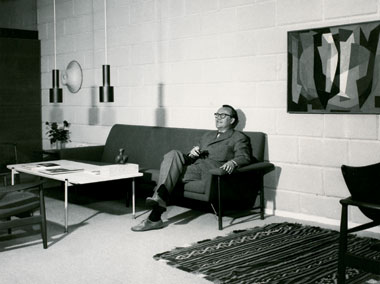
In 1937 Finn Juhl married the dentist Inge-Marie Skaarup  and when the highly art interested couple in 1942 were building their new house at Kratvænget in Ordrup, it was decorated with works of the Danish art painters of the time : Lundstrøm, Richard Mortensen, Eigill Jacobsen, Robert Jacobsen and others. Finn Juhl always saw his furniture as a part of the expression of the room and thought that furniture, handicraft and free art should created a completeness of the house, his own house being a school example of this idea. 


(Photos : arcspace.com)


For more please see : 
Finn Juhl by NoCollection:http://www.onecollection.com/FinnJuhl 

And Finn Juhl on obliqdesign : www.obliqdesign.com